THE HOME DEPOT ANALYTICS GROUP
Business Process Analysis
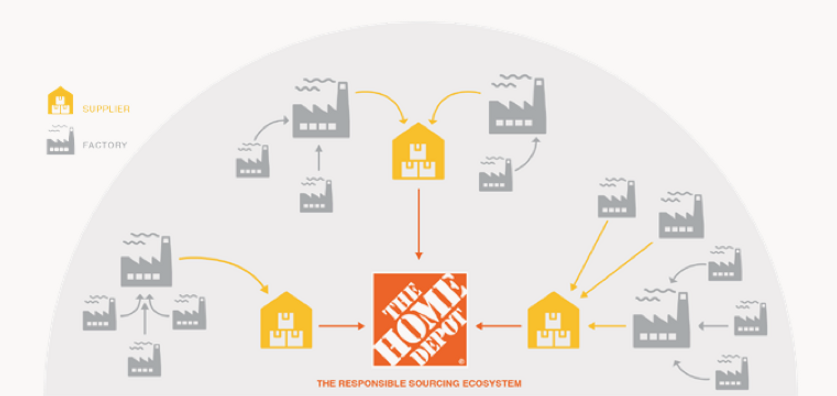
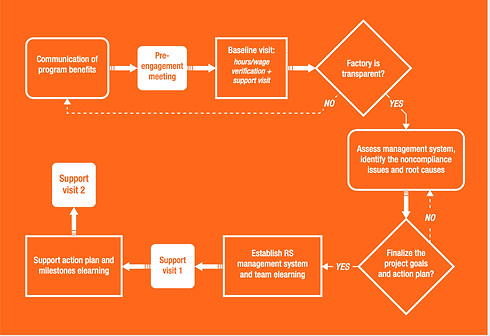
This event simulation model for The Home Depot shows the improved process for the newly proposed business model in selecting new vendors and suppliers with a focus on establishing stronger partnerships and relationships. This Business Process Analysis will assist THD in deeply examining internal processes to find opportunities for improvement in vendor and supplier selections (White, 2021). This BPA will also help identify processes that can be made more efficient or effective in vendor and supplier selection and assess whether processes are set up to align with business goals (White, 2021). The Home Depot sources merchandise from all over the world, and its Responsible Sourcing program was created to maintain and guide ethical practices throughout the global sourcing ecosystem, which includes vendors, suppliers, and factories (The Home Depot, 2021).
“Suppliers and Vendors are the liaisons between The Home Depot and the factories that manufacture products or source materials for use in products. They are responsible for distributing, communicating, and ensuring compliance with the Responsible Sourcing Standards. In the responsible sourcing ecosystem, factories represent a sizable majority. With that, suppliers must report all factories used for the production of products to The Home Depot, and all suppliers must have a designated point of contact for supervising factory compliance, reinforcing standards, and reporting to The Home Depot (The Home Depot, 2021).”
The selection process is a series of procurement steps to determine product or service requirements and match them with capabilities and pricing. There are generally 5 steps to this process which include: Determining business needs, vetting out potential vendors, setting evaluation criteria, connecting with and evaluating vendors, and lastly finalizing vendor selections (Cook, 2022).
Source: (The Home Depot, 2022) Made on Creatively.com
A Better Path Forward
The primary goal of The Home Depot, in partnership with selected suppliers, is to develop business relationships that provide for a sustainable supply of product while respecting the rights of workers. To accomplish this goal, The Home Depot has developed the Transparency and Improvement Program (TIP). TIP is designed to reinforce the need for transparency and provide factories the opportunity and support needed to improve management systems in a practical way and within reasonable time frames (The Home Depot, 2022)

Sales Strategy
Given the new business process, the strategy going forward will be to extend the benefits of stronger built relationships between The Home Depot, Suppliers, and Vendors, and share it with the consumers, especially those in the Professional sectors such as contractors, home builders, etc. The sales strategy going forward will target those specific personas more aggressively than the general or DIY consumer.
The sales strategy will use a technique called ‘K-means Clustering’ focuses on creating groups or clusters of related attributes within the professional sector. Once these clusters are created, other instances can be evaluated against them to see where they best fit. The steps in this type of analysis are to (Hiltbrand, 2018):
-
Specify the number of clusters (K) to be created (by the analyst)
-
Select randomly k objects from the data set as the initial cluster centers or means
-
Assigns each observation to its closest centroid, based on the Euclidean distance between the object and the centroid
-
For each of the k clusters update the cluster centroid by calculating the new mean values of all the data points in the cluster. The centroid of a Kth cluster is a vector of length p containing the means of all variables for the observations in the kth cluster; p is the number of variables.
-
Iteratively minimize the total within the sum of squares (Eq. 7). That is, iterate steps 3 and 4 until the cluster assignments stop changing or the maximum number of iterations is reached. By default, the R software uses 10 as the default value for the maximum number of iterations (Hiltbrand, 2018).